


Migration defines our global reality. More than 280 million people live outside their country of birth, of which 169 million are migrant workers — almost 5% of the world’s labour force. Migration has become a structural feature of modern economies: it fills labour gaps, enables skills transfer and sustains growth in ageing societies. Yet it also poses challenges of integration, protection of rights as well as irregular migration and exploitation.
Many countries have a dual role as both, countries of origin and destination for foreign workers while navigating rapidly evolving labour market needs, demographic pressures, and broader migration dynamics. This is also the case in the Central European Initiative (CEI) region, where labour migration patterns are dynamic and continuously evolving as economies restructure and demographics shift.
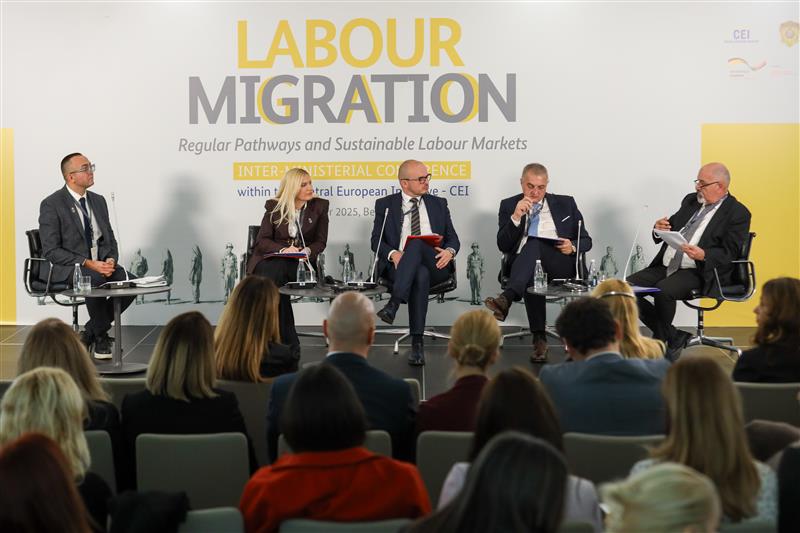
How to respond to these challenges was the main topic at the inter-ministerial conference titled Labour migration – Regular Pathways and Sustainable Labour Markets. It took place on 6-7 November 2025 in Belgrade under the Serbian Presidency of the CEI. The two global German Development Cooperation Programmes, Shaping development-oriented migration (MEG) and Centres for Migration and Development (ZME) as well as the International Organization for Migration (IOM) supported the event with their expertise and good practice examples.


Opening addresses 1 – Milica Đurđević Stamenkovski, Minister for Labour, Employment, Veterans and Social Affairs of Serbia
Opening addresses 2 – Anke Konrad, Ambassador of the Federal Republic of Germany Belgrade
For two days, ministers and experts from CEI member states, representatives of international organizations, academia and civil society jointly explored current trends, policies and opportunities related to labour migration.


The conference brought together 29 distinguished panelists across six thematic panels and facilitated in-depth, diverse and forward-looking discussions. The discussions addressed key dimensions of regular pathways and sustainable labour markets, with a strong focus on:
- International Instruments and Practices
- Legislative Frameworks and Comparative Practices
- Labour Mobility and Market Stability
- Visa Policy and Institutional Coordination
- Prevention of Labour Exploitation and Rights Violations
- Human Trafficking in Labour Migration

Throughout these sessions, it became clear that labour migration, when well-governed, can serve as a catalyst for economic resilience, social cohesion and regional integration, and that the way forward lies in regional solidarity, data-based policymaking, ethical recruitment, institutional cooperation and human-centred governance. With its expertise, GIZ is well positioned to promote migration in a way that benefits all parties involved.

Check impressions of some of the conference participants.